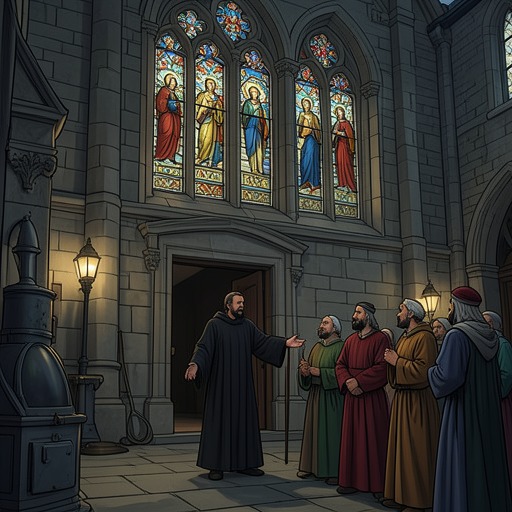
Rebellion of La Rochelle
The Three MusketeersRebellion of La Rochelle is the armed Huguenot resistance centered on La Rochelle, the last major Calvinist stronghold remaining in the France of Louis XIII. In the novel, it is not merely a local revolt but the point where religious conflict, foreign alliances, royal power, naval logistics, starvation, and private passion become one crisis. The city’s survival depends on endurance and the hope of Buckingham’s relief fleet; the crown’s victory depends on blockade, persuasion, and the destruction of the last Protestant refuge open to England.
Religious and Political Background
The rebellion emerges from the unsettled political order of seventeenth-century France. La Rochelle is presented as the last of the important cities granted to the Huguenots as places of safety after the other Calvinist strongholds had fallen. For Cardinal Richelieu, its continued existence represents more than religious disagreement: Calvinist resistance is mingled with civil revolt and foreign war, making the city a dangerous center of opposition to royal authority. Destroying it therefore becomes both a military objective and a project of state consolidation.
La Rochelle also possesses exceptional strategic importance because its harbor is the last port in the French kingdom still open to the English. Closing that port would weaken England’s access to the French coast and complete what the narrative describes as the work begun by Joan of Arc and the Duc de Guise. The rebellion is consequently both domestic and international. Spaniards, Englishmen, Italian malcontents, adventurers, and soldiers of fortune from many sects gather under the Protestant standard, forming a trans-European association whose branches extend across Europe. The city’s resistance thus draws strength from a wide network while exposing France to the danger of foreign intervention.
The wider political atmosphere is already defined by overlapping wars. Nobles fight one another; Louis XIII struggles with Cardinal Richelieu; Spain fights the king; and robbers, mendicants, Huguenots, wolves, and other outcasts seem to make war upon everyone. This habitual condition of alarm explains why the citizens of Meung readily seize arms at any public disturbance, but it also places the rebellion within a world where military force, religious suspicion, and political loyalty are inseparable.
Siege, Foreign Relief, and Military Pressure
The rebellion becomes inseparable from the Siege of La Rochelle and from the wider Anglo-French conflict. The Duke of Buckingham enters the struggle under the pretext of defending England’s honor, but his political purpose is joined to private vengeance and to his desire to enter France as a conqueror rather than as an ambassador. The real stake, beneath the claims of kingdoms and religions, is identified with the favor of Anne of Austria. The city’s fate is therefore tied to the concealed emotional rivalry between Buckingham and Richelieu as well as to their public opposition.
Buckingham’s first advantage is dramatic and substantial. He appears unexpectedly before the Isle of Ré with ninety vessels and nearly twenty thousand men, surprises the Comte de Toiras, and lands after a bloody conflict. Toiras withdraws into the citadel of St. Martin, while a hundred men occupy the fort of La Prée. The operation gives the rebellion a powerful external ally and makes the possibility of relief seem real, even though the English invasion cannot immediately break the French position around La Rochelle.
The material conditions of the campaign steadily turn against the English. Their soldiers, dependent on good food for their effectiveness, are reduced to salt meat and bad biscuit, and illness spreads through the camp. Rough seas destroy small vessels daily, while the coast is covered at every tide with the wrecks of pinnacles, roberges, and feluccas. These logistical pressures mean that the French need not always defeat Buckingham in open battle; weather, hunger, disease, and maritime deterioration gradually make continued occupation impossible. When the English are beaten in repeated encounters and defeated in the passage of the Isle of Loix, they are forced to re-embark, leaving two thousand men dead, including five colonels, three lieutenant colonels, two hundred and fifty captains, and twenty gentlemen of rank. Four cannon and sixty flags are captured and taken to Paris.
The rebellion’s military drama is therefore governed by infrastructure as much as by individual courage. The French blockade is reinforced by the dyke, which prevents vessels from entering the besieged city. Although the city is invested and eventual success appears likely, the blockade may still last a long time, creating an affront to the king’s army and a serious inconvenience for Richelieu. The rebels remain dangerous not because victory is assured, but because their endurance keeps the French monarchy from converting military investment into immediate political submission.
Hunger, Mutiny, and Negotiation
Inside La Rochelle, resistance is tested by starvation. The mayor’s perseverance is described as extraordinary, yet the city reaches the point at which inhabitants attempt a mutiny in favor of surrender. The mayor responds by hanging the mutineers. That execution suppresses the immediate revolt, and the inhabitants choose to die of hunger rather than accept surrender, regarding strangulation as a swifter and more certain death than famine.
The besiegers and the besieged fight an additional war through messengers and spies. Couriers sent from La Rochelle to Buckingham and spies sent by Buckingham into the city are regularly captured, and the punishment is immediate: Richelieu orders them hanged. The king is even invited to watch the executions, which provide him with grim entertainment and help him endure a siege he finds tedious. Intelligence becomes a weapon equal to artillery, because the city’s hope depends on whether Buckingham can still communicate with it and whether relief remains possible.
One captured letter reveals the extremity of the situation. It tells Buckingham that La Rochelle is at the point of collapse, but not that it will surrender if help does not arrive within fifteen days. Instead, it declares that if help comes after that period, the inhabitants will already be dead from hunger. The message makes the city’s condition precise: the issue is no longer simply military defeat but whether aid can arrive before the population disappears. Buckingham becomes the city’s Messiah, and the rebels’ courage is sustained by the expectation of his intervention.
Richelieu responds with psychological as well as military pressure. He has notes thrown over the walls accusing the leaders of selfishly preserving their grain while women, children, and old men die. The notes challenge the maxim that civilian deaths do not matter so long as the men defending the walls remain strong, reminding the inhabitants that those starving people are their own sons, wives, and fathers. The appeal to shared misery produces concrete political results: many inhabitants begin private negotiations with the royal army.
That movement toward negotiation is abruptly reversed by news from Portsmouth. An inhabitant who has crossed the royal lines enters La Rochelle claiming to have seen a magnificent fleet ready to sail within eight days. The announcement is strengthened by Buckingham’s promise that a great league will soon unite against France and that English, Imperial, and Spanish armies will invade the kingdom. The letter is read publicly, copied, and posted at street corners. Those who had begun negotiations suspend them, choosing to await the promised relief. The rebellion thus survives another crisis through information and expectation, even though the credibility of the promised fleet remains uncertain.
Royal Power and the Private War Behind the Revolt
The suppression of the rebellion displays the developing power of the French monarchy and of Richelieu’s political system. Louis XIII and Richelieu each maintain a formidable body of Musketeers, and their rivalry turns military retainers into instruments of court competition. Although both publicly condemn duels and brawls, they secretly encourage their men to quarrel and take intense pleasure or disappointment in the outcomes. The same culture of personal combat that shapes the adventures of d'Artagnan and the three Musketeers therefore belongs to the state’s political machinery.
The crown’s authority is also shown in its uneven treatment of violence. Louis XIII insists that an edict remains an edict and that fighting is forbidden, yet he accepts the distinction between an illegal duel and a brawl in which five of the cardinal’s Guardsmen confront three Musketeers and d'Artagnan. He orders the case sent to judges, declaring that judgment belongs to them, while M. de Treville warns that even the purest life and most incontestable virtue cannot protect a man from infamy and persecution. The rebellion exists within this same contradiction: royal law presents itself as universal, but political necessity continually determines how violence is classified and punished.
The personal rivalry around Anne of Austria gives the siege an additional motive force. Richelieu’s campaign against La Rochelle is directed toward the strategic isolation of England, while Buckingham’s intervention is shaped by his desire for Anne’s favor and by his private vengeance. Anne later writes to Buckingham urging him to countermand the armaments being prepared against France and to end a war publicly justified by religion but widely understood to conceal his love for her. She warns that the conflict may bring catastrophe to England and France and threatens Buckingham’s life. The letter reveals how the rebellion’s international stakes are entangled with a concealed emotional cause.
The same network of political danger reaches d'Artagnan and Milady. Milady’s defeat and loss of liberty are connected to d'Artagnan’s interference with Buckingham, whose enemy she hates, and to the secrets d'Artagnan has exposed. Her attempt to use Richelieu’s carte blanche for vengeance belongs to the same world of covert authorization, international rivalry, and personal retaliation that surrounds La Rochelle. The rebellion is thus not a remote historical background: it supplies the pressure under which missions to England, letters, disguises, imprisonments, and acts of revenge acquire their urgency.
Significance and Outcome
Rebellion of La Rochelle functions as the novel’s great public crisis, enlarging the scale of the narrative from duels and clandestine errands to the fate of a city and the balance between France and England. Yet the narrative never allows the military spectacle to become detached from human vulnerability. The dyke, the wrecked ships, the spoiled provisions, the hanged messengers, the mutinous inhabitants, and the starving families show that political decisions are enacted through bodies, food, weather, and communication.
The rebellion also exposes the limits of heroic hope. La Rochelle’s resistance is sustained by Buckingham’s expected arrival, but the English position is undermined by disease, poor food, rough seas, and repeated defeat. Richelieu’s private negotiations begin to weaken the city from within, while Buckingham’s public promises briefly restore its courage. The conflict turns on the interval between relief announced and relief delivered. In that interval, hope becomes a military resource, and rumor can reverse negotiations as effectively as force.
Ultimately, the rebellion is contained by the convergence of royal authority, blockade, military pressure, hunger, and political manipulation. Its defeat strengthens Richelieu’s reputation and advances the centralizing ambitions of Louis XIII’s government, while the collapse of English intervention removes the last realistic external support for the city. The rebellion remains significant because it reveals the machinery beneath the novel’s romantic adventures: private loyalties move through state institutions, love helps provoke international war, and the fate of a religious community is decided through the combined operations of armies, harbors, hunger, intelligence, and court power.